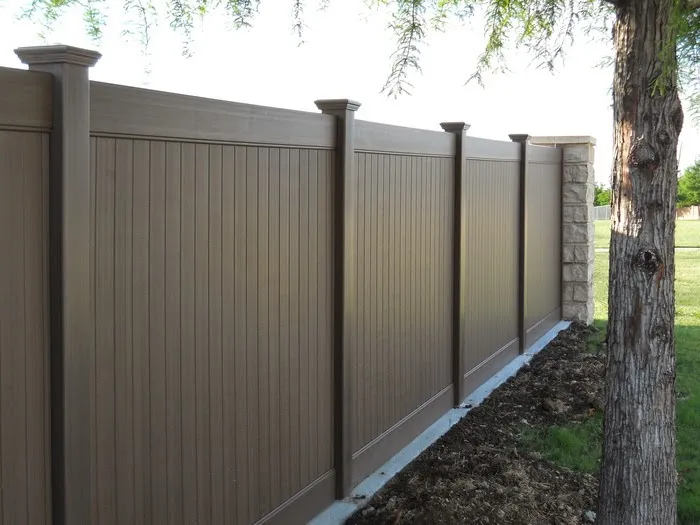
Wood costs less up front: the national figures are $20 to $50 per foot installed for wood and $30 to $60 for vinyl. After that the costs reverse. Vinyl needs a wash now and then. Wood needs sealing every few years and the odd new board, and that upkeep closes part of the gap over time.
The price ranges on this page are national figures that HomeGuide published for 2026. They are not quotes from us. What a fence costs in the Sacramento area depends on local labor, the price of lumber and steel that month, and what your yard is like. Last checked October 2026.
| Wood | Vinyl | |
|---|---|---|
| Installed cost per foot | $20 to $50 | $30 to $60 |
| Upkeep | Sealer or stain every few years | Wash with a hose |
| Weak point | Posts rot where sprinklers keep the soil wet | Heat and sun; a hard knock can crack it |
| Repairs | One board at a time | Usually a whole panel |
| Look | Natural grain, takes any stain | Uniform finish, fewer colors |
Redwood, cedar or pressure-treated pine?
Use redwood or cedar for the boards and pressure-treated pine for the posts. Redwood has long been the standard fence board in Northern California, and cedar is its close rival. The heartwood of both resists decay without chemical treatment and stays flatter than pine as it dries in the heat. Posts are a different job, since they sit in the ground, and treated lumber is rated for ground contact. That pairing is what most Sacramento fences are made of.
Which fence lasts longest in valley heat, sun and winter rain?
Aluminum and vinyl, because neither can rot. Sacramento has no real freeze and thaw, so the worries of cold climates do not apply here. Heat and sun are what count. Months of dry air and afternoons over 100 degrees pull moisture out of wood until boards cup, split and loosen their nails. Vinyl handles sun well in white and light tones, while dark vinyl soaks up heat and can warp or sag. For any wood fence, keep sprinklers off it, keep soil and mulch away from the boards, and seal the sunny side.
What type of fence is best for my yard?
| You want | Good choices | Keep in mind |
|---|---|---|
| Privacy | 6-foot redwood, cedar or vinyl | 6 feet is the city limit on most rear and side lines |
| A large dog | 5 or 6 foot wood, vinyl or chain link | Close the gap at the bottom |
| Small children | A solid fence with a self-latching gate | Put the latch out of reach |
| A pool | Aluminum or vinyl built to the state barrier rule | 60 inches minimum, gate inspected |
| Lowest cost | Chain link | Not allowed in city front or street side setbacks |
| Low upkeep | Vinyl or aluminum | Choose light colors for the heat |
| A taller front fence | Open wrought iron or tubular steel | Up to 6 feet in the city if open and decorative |
Is aluminum fencing strong enough for a large dog?
Yes for most dogs. Height and picket spacing matter more than the metal. A jumper needs a taller panel. A small dog can squeeze between standard pickets, so choose a panel with closer spacing along the bottom. A dog that throws its weight at the fence every day is better behind steel or a solid fence.
We have a large dog, want privacy and do not want to spend a fortune. What makes sense?
A plain 6-foot dog-ear fence in a standard board grade. It blocks the view, it is tall enough for most big dogs, and it is the least expensive solid fence. You can save more by building it only where people can see in and using chain link on a back line that faces a wall, a hedge or open space.
My neighbor has wood and wants me to match it so we can split the cost. I want vinyl.
The line you share can only carry one fence. Agree on one material for that stretch and write down how the cost is divided. Everywhere else on your lot the choice is yours alone. If you cannot agree, you are free to build your own fence a little inside your boundary and pay for it yourself.
Will the new fence look the same on my neighbor's side?
Not unless you pick a style built for it. Shadowbox, board-on-board and most vinyl panels look alike from both yards. A standard board fence has a smooth face and a face with the rails showing. A common answer on shared lines in Sacramento is to alternate the panels, so each yard sees the smooth face on every second section. Decide it with your neighbor before we build.
A real price needs a tape measure on your fence line. The visit costs nothing and the quote comes in writing. Call (916) 890-2911 or text us a photo of the fence.